
Artists : Lisa Streich, Mads Emil Dreyer & Yarn/Wire
[ concert ]
Time :
Fri • 19:30 - 20:30
Location : Åbne Scene
The acclaimed American quartet Yarn/Wire sets the tone for both Mads Emil Dreyer from Denmark and Lisa Streich from Sweden.
Info about the pieces
-
A reflection on the love of the orchestra and its potential transitoriness. Can you realize the possibilities of the orchestra with only four musicians and eight motors?
—
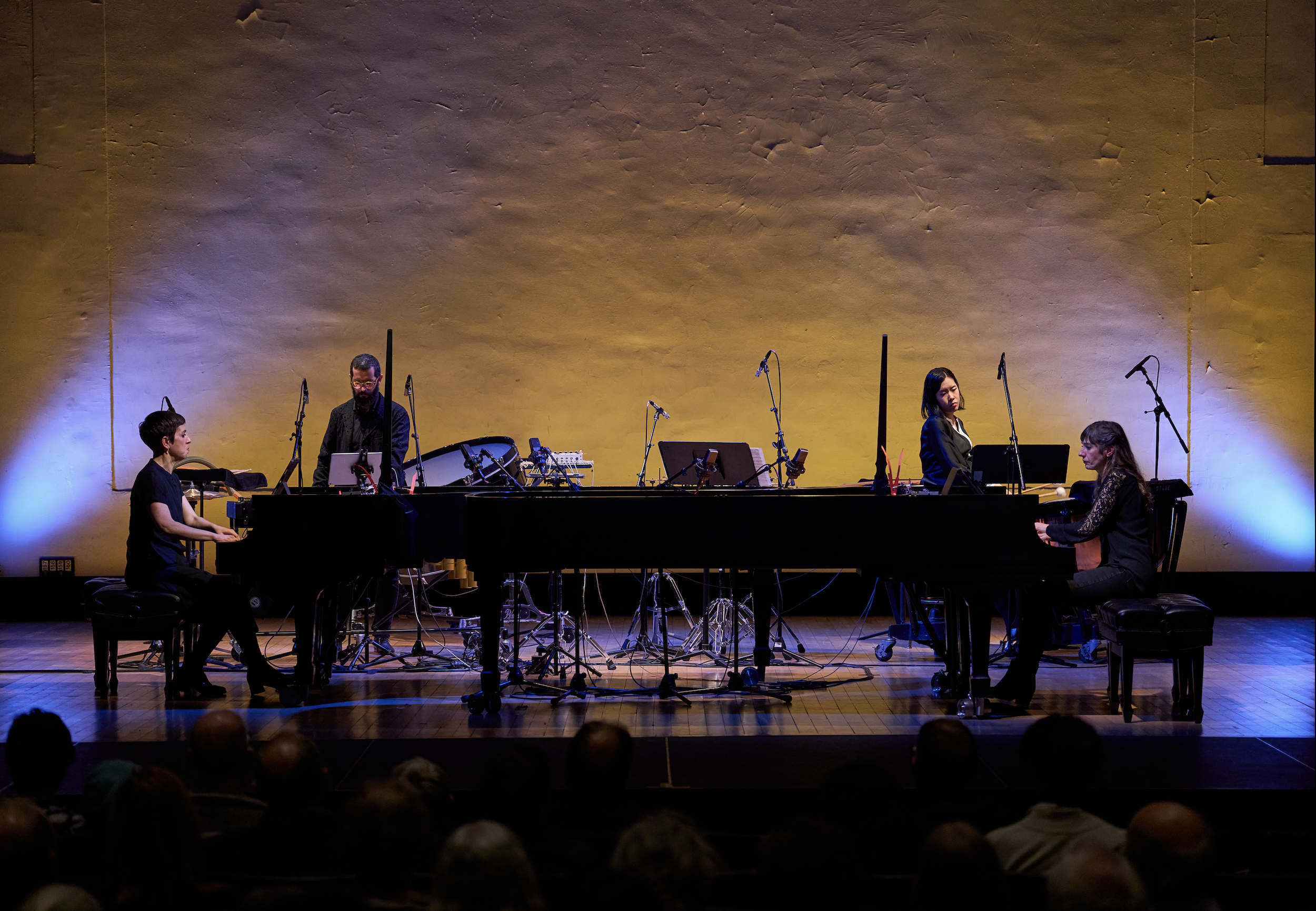
Orchestra of Black Butterflies is Lisa Streich’s reflection on the love of the orchestra and its potential transitoriness. It deploys a formation of four musicians who try to portray the orchestral apparatus.
The two pianos are tuned a quarter-tone apart and are both motorized. In the two pianos, both wind and string instruments are at the performer’s disposal. The wind instruments play their keys in the regular way, whereas the string instruments play through the paper strips, which are attached to motors. Additionally, there is orchestral percussion – timpani, triangle and cymbals.
The percussion takes turns using the fader box that controls the motors in the pianos. Thus, they are sometimes soloists with orchestral percussion – and sometimes co-repetitors with the fader box. On the one hand, the piece aims to illustrate spectral chords with just four musicians, and, on the other hand, to chase something utopian: Can you realize the possibilities of the orchestra with only four musicians and eight motors?
The work reflects Streich’s interest in the imperfection of familiar beauty and the amplification of expressions through spectral changes in intonation.
-
Quiet music in five parts for lyre harps played with and without e-bows, music box, and table percussion.
—
The Letting Go is a quiet, almost ritualistic piece written by Mads Emil Dreyerfor the American quartet Yarn/Wire. It consists of five short movements and the total duration is around 15 minutes. The performers play small lyre harps with and without e-bows, a music box, and a selection of table percussion instruments.
The piece is inspired by finding new instruments and setting up dialogues between them. The sonic opportunities that come out of this process and the feedback mechanism between abstract ideas of sound – and the curiosity of actual music-making – are what drive the inspiration.
The title refers to the act of accepting the current situation you find yourself in. In a biblical sense, this might mean surrendering to God’s will. However, the piece is not a religious piece. Nor is it autobiographical in a direct sense, although it was written during a time when Dreyer was thinking quite a lot about how to come to terms with the disjoint between one’s ideals and what reality actually looks like. The piece was commissioned by SPOR festival.
-
Web: https://www.yarnwire.org/
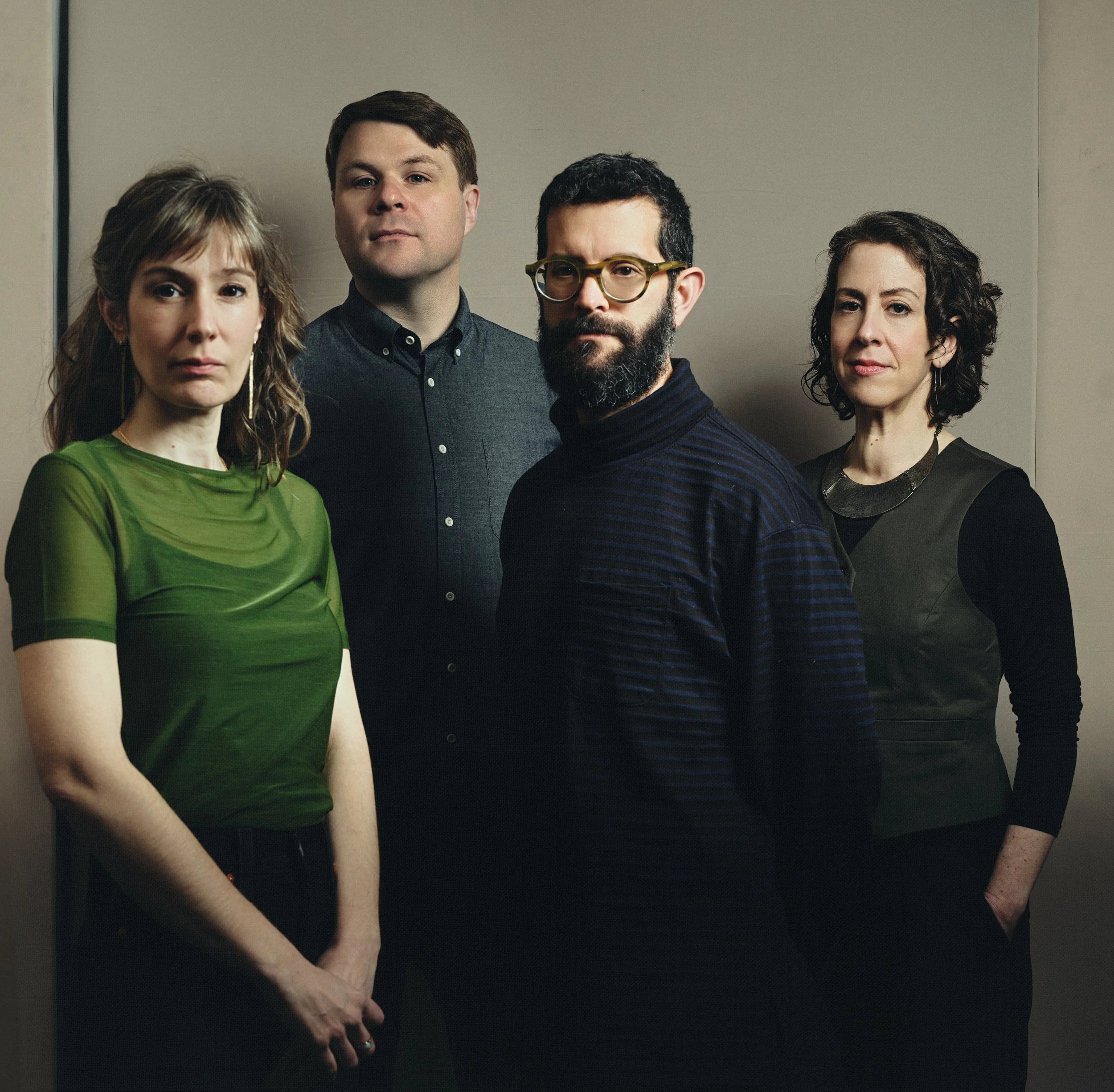
Yarn/Wire is a New York City-based percussion and piano quartet consisting of Russell Greenberg and Dustin Donahue on percussion and Laura Barger and Julia Den Boer on pianos. Together, they create visceral, adventurous new music at the intersection of concert tradition and sonic experimentation.
Since forming in 2005, the ensemble has become a fixture at the world’s preeminent concert halls and music festivals, performing at venues and events including Lincoln Center, the Library of Congress, Big Ears Festival, Donaueschinger Musiktage, Rainy Days, Wien Moderne, and Time Spans.
Through more than two hundred commissions, Yarn/Wire has championed composers including Annea Lockwood, Enno Poppe, Michael Gordon, George Lewis, Sufjan Stevens, Sarah Hennies, Tyshawn Sorey, Peter Evans, Alex Mincek, Craig Taborn, Tyondai Braxton, and Kate Soper, among many others.
The ensemble’s ongoing commissioning series, Yarn/Wire Currents, serves as a launchpad for bold new works in partnership with Brooklyn-based institutions including Roulette, Blank Forms, and ISSUE Project Room. Since 2014, Yarn/Wire has also hosted the annual Yarn/Wire International Institute and Festival, bringing together emerging composers and performers from around the world to explore new possibilities in contemporary music.
A strong advocate for education, the ensemble has presented workshops, masterclasses, and residencies at institutions worldwide including Harvard, Princeton, UC Berkeley, Columbia in the US, and Bern Academy of the Arts in Switzerland.
-
Web: www.lisastreich.se
Lisa Streich (1985) is a Swedish composer, who works with motorized instruments of her own creation in her music. She is fascinated by the de-subjectivization of sound, which for her becomes universal, speaking of and for everyone. She is also interested in the incongruent contrasts that can arise on both visual and auditory levels at the same time. Likewise, she pursues a keen interest in imperfect, well-known chords from recordings which she decidedly takes apart and weaves – sometimes with 40 voices – throughout an orchestral movement.
Streich has received commissions from the Lucerne Festival, Berliner Philharmoniker, Kölner Philharmonie, Swedish Radio Choir, Gothenburg Symphony Orchestra, Ensemble intercontemporain, Staatstheater Hannover, Munich Chamber Orchestra, and the Shizuoka Concert Hall. Her music has seen performances from the NDR Elbphilharmonie Orchestra, Deutsches Symphonie-Orchester Berlin, Swedish Radio Orchestra, Norrköping Symphony Orchestra, and Malmö Symphony Orchestra on the occasion of the 250th anniversary of the Royal Swedish Academy of Music with a commission for a Concerto Grosso, Quatuor Diotima, ensemble recherche, the Eric Ericson Kammerchor, Nouvel Ensemble Moderne Montréal, Ensemble Musikfabrik, and many others. Lectures on her music have taken place at the Royal College of Music Stockholm, the Columbia University New York, the Sibelius Academy Helsinki, and at the CRR de Paris.
-
Like glistening sculptures, the music of Copenhagen-born Mads Emil Dreyer (1986) exists as much in its own forms as in the listener’s individual response to them. His music creates conscious hinterlands in which detailed, focused sounds can be observed, like an artwork unfolding in time.
His versatility and flexibility have made him a favourite on Copenhagen’s new music scene and far beyond. As interested in knobs and buttons as he is in violins and flutes, Dreyer often sets up a dialogue between electroacoustic and acoustic entities.
His music might use electronics to blur tonal harmonies, mimic acoustic sounds or place a fog around regimented instrumental robotics. Sometimes, electronics are deployed to counterbalance music with vision, presenting sound and image as two sides of the same process. Lightness and brightness, beauty and poetry are all over Dreyer’s works.
A characteristic method is to use minimal themes gently repeated or painstakingly metamorphosed. Radiant explorations of timbre might be used to distract from a neat, diatonic harmonic process. Shapely songs or lullabies might be stretched over deep electroacoustic throbbing or long drones.
Dreyer’s music has been credited in the press for its humanity, beauty, technical discipline and aesthetic focus. He has written for, among others, the Danish National Symphony Orchestra, JACK Quartet, Ensemble Recherche, Ensemble Adapter, Athelas Sinfonietta, Neue Vocalsolisten, Scenatet and Curious Chamber Players and is a founding member and house composer of the contemporary music group NEKO3.
Supported by Ernst Von Siemens Music Foundation.